Fundamental Bioinformatician Course in Python
About Course
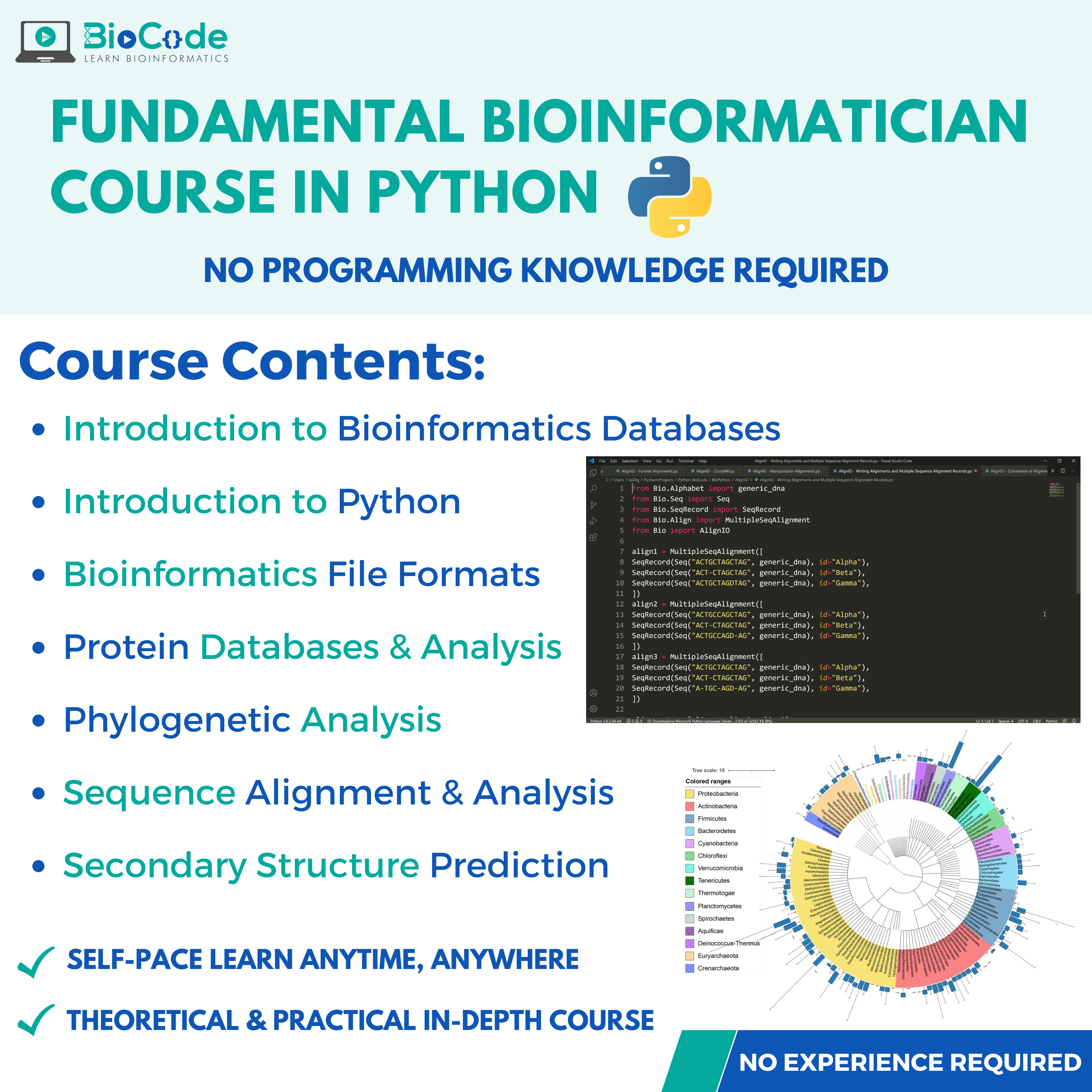
Fundamental Bioinformatician Course in Python Allows You To Develop The Basic Bioinformatician & Programming Skills in Python
Being a Bioinformatician means you’ve to learn how to retrieve and analyze biological data in the most efficient way, to learn how to align & analyze biological sequences to predict the evolutionary histories between them, to find out the conserved patterns, to learn how to predict coding regions or genes from a raw nucleotide sequence, and much more.
To efficiently deal with huge genomic and proteomic data often requires writing short scripts or patches of code to computationally analyze the biological datasets, rather than comparing and analyzing such huge datasets manually. Hence, the major part of Bioinformatics involves computationally analyzing biological datasets.
The simple syntax and high-level data structures of Python, make it easier for nonprofessional programmers such as computational biologists to develop programming skills, enabling them to interact with data programmatically and eventually develop code on their own.
In this course you’ll learn the very basics of most commonly utilized biological databases, how to find conserved and variable regions within sequence alignments & analysis and do evolutionary & phylogenetic analysis. You’ll also be able to learn various concepts related to how to write your first script, Python data structures such as lists, strings, dictionaries and more. Along with, how to read/write Bioinformatics files, work with loops and how to control the flow of your program and script.
Joining and learning from the Fundamental Bioinformatician Course in Python can enhance your biological career by learning through various useful & informative pre-recorded lectures on Bioinformatics tools, databases, servers and biological programming languages.

The same foundation, taught entirely in Python
This course covers the core bioinformatics skills — databases, file formats, protein analysis, alignment, phylogenetics and structure prediction — with Python as the single language throughout, across 18 hours 8 minutes and eight sections.
It exists because splitting a beginner’s attention across two languages slows both down. If you already know Python is the direction you want, learning one language properly beats meeting two briefly.
What it covers
- Bioinformatics databases — retrieving data from the major repositories, programmatically where it helps.
- File formats — parsing and converting the formats biological data arrives in.
- Protein databases and analysis — characterising proteins from sequence.
- Sequence alignment and analysis — running and interpreting alignments.
- Phylogenetic analysis — constructing and reading trees.
- Secondary structure prediction — inferring structure from sequence.
- Python — taught throughout and applied to each of the above, rather than as a separate block you are left to connect yourself.
Why Python for bioinformatics
Python dominates where bioinformatics meets machine learning, and Biopython handles most routine sequence and structure work. If you expect to move toward single-cell analysis, protein language models or any predictive modelling, Python is the language those ecosystems are written in. R remains stronger for classical statistics and differential expression — many working bioinformaticians eventually use both, but there is no advantage in learning them simultaneously.
What you can do afterwards
Write Python that retrieves biological data, parses standard formats, runs alignments and builds phylogenies — and read other people’s bioinformatics Python without difficulty. It also prepares you directly for our Python and BioPython training.
Who it suits
Beginners who have decided on Python, researchers whose group already works in Python, and anyone planning to move into machine learning applied to biological data. No prior programming experience is assumed.
Learning path
From zero to bioinformatician
- 1 Introduction to Bioinformatics & Its Advancements
- 2 Fundamental Bioinformatician Course in Python · you're here
- 3 Advanced Bioinformatics Scripting: Python, BioPython, R, BioConductor & Linux
- 4 Extensive Bioinformatician Course
Not ready to enrol?
Get the free syllabus & course updates
We'll email you the full outline for this course plus a starter guide — no spam, unsubscribe anytime.
Tools & technologies you'll use
- Python
- R
- Conda
- BioPython
- Machine Learning
Course Content
Bioinformatics Databases
-
Introduction to National Center of Biotechnology Information (NCBI)
18:02 -
Sequence Analysis
17:59 -
Sequence Retrieval from NCBI
16:17 -
PubMed Central & ENTREZ
11:07 -
GenBank: Nucleotide Database on NCBI
06:50 -
FASTA vs GenBank
18:26 -
Gene Database: A Comprehensive Gene Database
30:21 -
NCBI Genomes & NCBI Assembly: Retrieval of Genomes
36:14 -
RefSeq Database: Retrieval of Single Reference Sequences
11:16 -
BLAST Database Searching
25:37 -
Introduction to UCSC Genome Browser & SARS-CoV2 Viral Genome
13:40 -
Retrieve an Entire Genome & Retrieval of SARSCoV-2 Viral Genome
09:41 -
Retrieval of Genomic Data & Annotation of SARSCoV-2 Viral Genome
05:30 -
Introduction to ENSEMBL
07:50 -
Retrieval of a Gene-Protein-Chromosomal Region
18:02 -
Introduction to Phytozome
09:39 -
Interpret Plant Genome Records
09:07 -
Download an Entire Plant Genome & Proteome
26:41
Bioinformatics File Formats
Protein Databases & Analysis
Sequence Alignment & Analysis
Phylogenetic Analysis
Secondary Structure Prediction
Python
Exercise
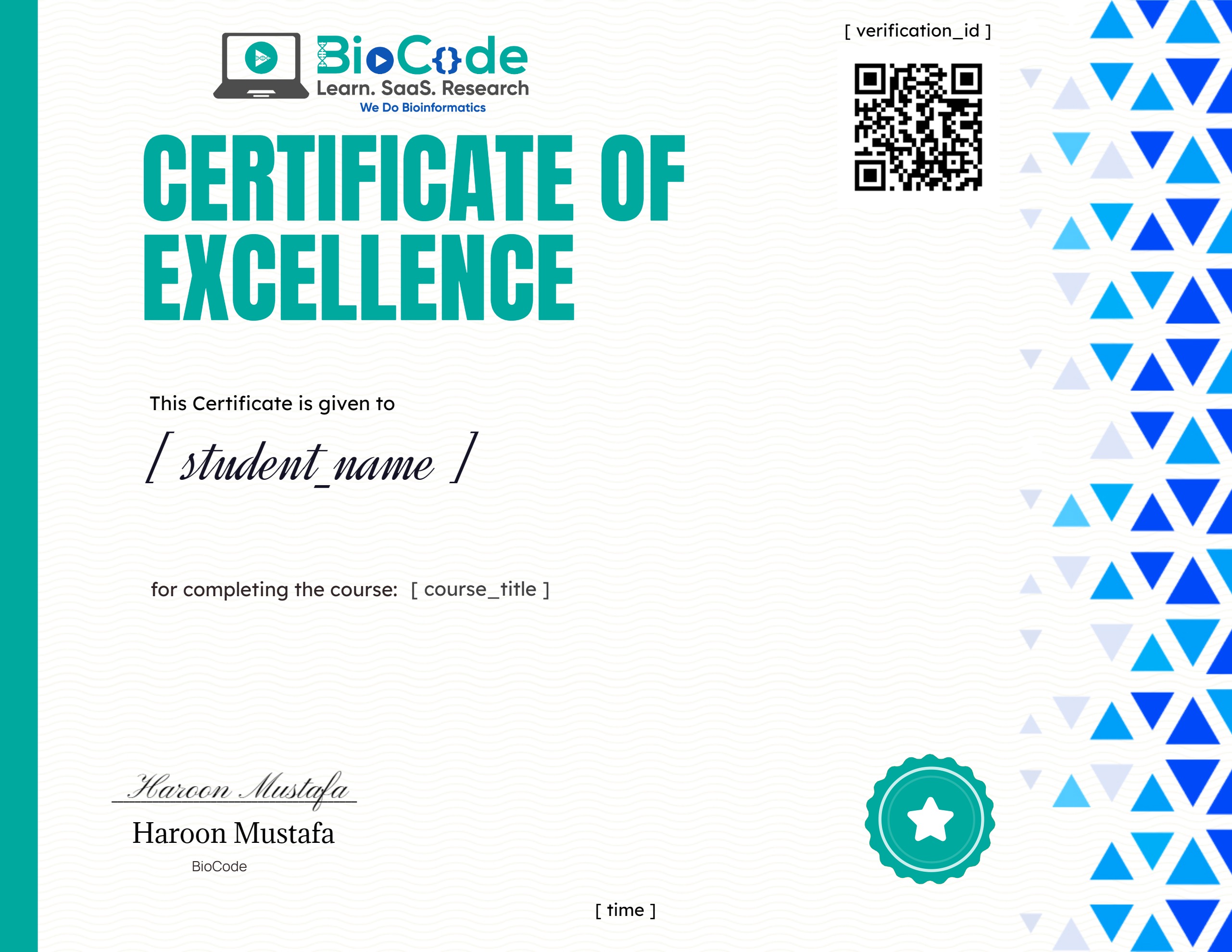
Earn a certificate
Add this certificate to your resume to demonstrate your skills & increase your chances of getting noticed.
Student Ratings & Reviews
Who this course is for
- The target audience for the Basic Bioinformatician Course in Python are biologists, beginner or intermediate Bioinformaticians or data analysts with no or little experience in applications of computational bioinformatics and analysis.
- However, a superficial understanding of molecular biology and logic development for coding is expected from you before you join the course.
- Bioinformatics is quite easy to get started in, even if you lack a proper understanding of the underlying concepts of Bioinformatics databases, servers, tools and the algorithms working behind them.
Common questions
Do I need any prior experience for this course?
The course is taught from first principles, so you do not need previous experience with the specific tools it covers. A working understanding of molecular biology will help you get more from it.
How long does Fundamental Bioinformatician Course in Python take to complete?
The course contains roughly 18 hours 8 minutes of material across 8 sections. It is self-paced, so you can work through it as quickly or slowly as suits you.
How long do I have access after enrolling?
Access is lifetime. Once you enrol you keep the course and any future updates to it, with no recurring fee.
Do I get a certificate?
Yes — you receive a certificate of completion once you finish the course, which you can share on LinkedIn or include in a CV.
Is this course hands-on or theory only?
It is project-based. You work with real research datasets and run the analyses yourself rather than only watching them being explained.