Hands-on: Single-Cell RNA-Sequencing Data Analysis Using Python [Complete Training]
About Course
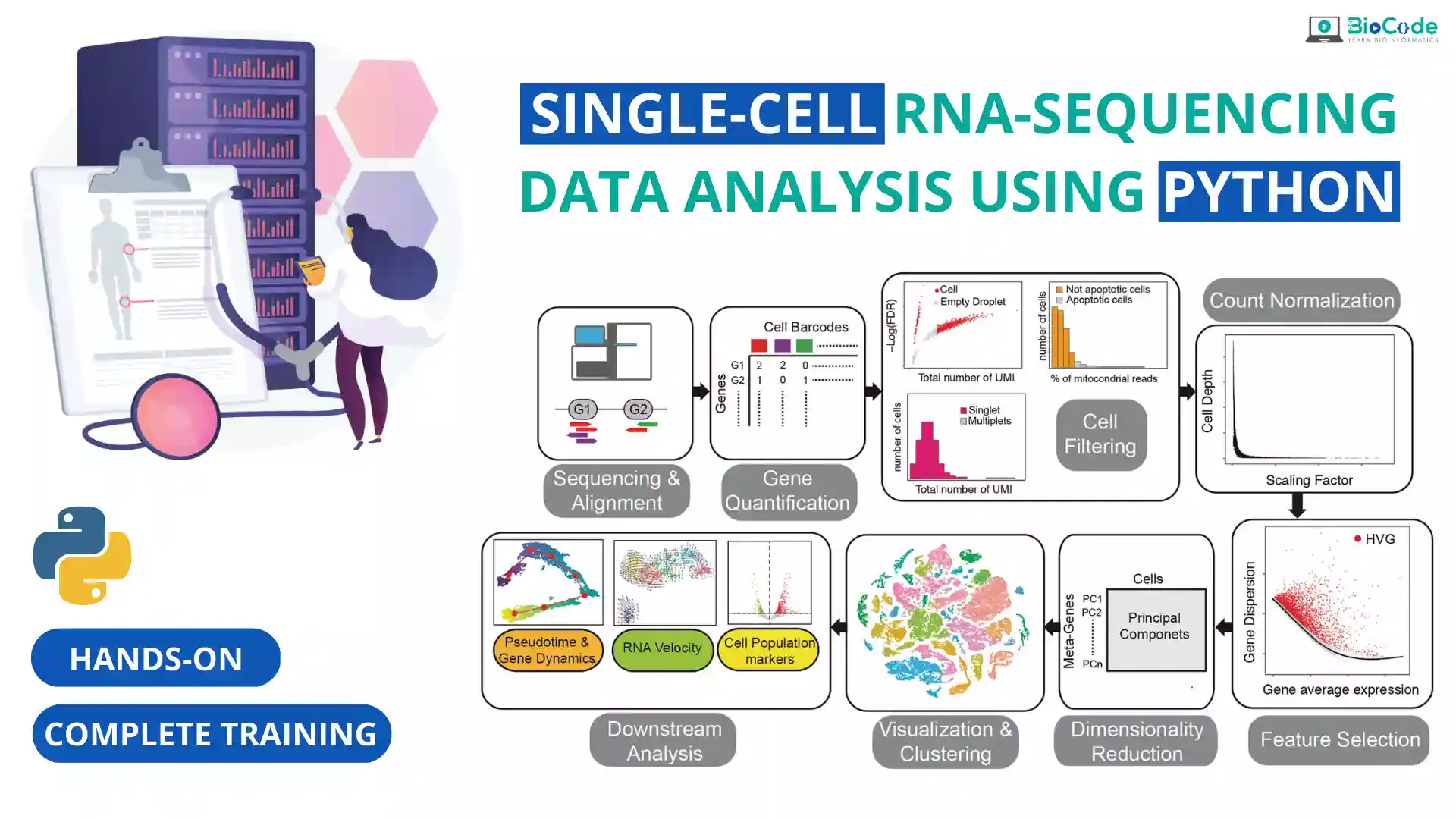
We present a comprehensive single cell RNA-seq data analysis course designed for beginners and advanced researchers in Life Sciences who are interested in exploring the exciting field of single cell genomics. No prior Python programming or Linux knowledge is required. This course is focused on the analysis of scRNA-seq data using command-line tools and Python packages, including Scanpy and other relevant Python packages (see course content section).
Throughout the course, we will explore the differences between scRNA-seq and bulk RNA-seq, and why scRNA-seq is essential for studying cellular and tumor heterogeneity.
This course is ideal for anyone without any prior knowledge of scRNA analysis, as it provides complete guidance and hands-on training from theground up.
We cover all scRNA technologies with an emphasis on 10x Genomics and Smart-seq2. We teach both theory and hands-on experience of each topic in the entire pipeline. We guide students on how to take raw scRNA datasets, install software and Python packages, perform UMI and cell barcode filtering, align against reference genome, and subsequently perform deduplication and quantification (count matrix).
Our course teaches students how to utilize Python programming (ScanPy package) to perform quality control on scRNA data, remove unwanted dead cells that may hinder analysis results, perform normalization, scaling, data imputation, and dimension reduction, and create visualizations through UMAP, tSNE, and PCA plots. We also provide instruction on cell clustering and identifying cell subpopulations in samples, annotating them (cell annotation), and conducting cell lineage and trajectory analysis of the cells.
Finally, we teach students how to analyze differentially expressed genes in either all of the subpopulations or their chosen subpopulations of cells, identifying marker genes that are only expressed in their chosen subpopulations.
By the end of the course, students will have a comprehensive understanding of single cell RNA-seq data analysis using Python packages, and be equipped to tackle their own single-cell sequencing projects.
Single-cell RNA-Seq in Python, from raw data to annotated populations
This is the Python route through single-cell analysis, built on Scanpy and the scientific Python stack. It covers the same ground as our command-line and R training, and suits you if Python is already your language or if you intend to extend the analysis with machine learning afterwards, where the Python ecosystem is stronger.
No prior Python is assumed. The programming is taught alongside the biology rather than as a prerequisite.
What you work through
- The biology first — cellular and tumour heterogeneity, and where single-cell resolution answers what bulk RNA-Seq cannot.
- Bulk versus single-cell — the design decision, and what each approach can and cannot support.
- Single-cell technologies — how the platforms differ and what that means for your analysis choices.
- The 10x Genomics pipeline — raw sequencing output through to a count matrix.
- Quality control — filtering low-quality cells, mitochondrial content, and identifying doublets.
- Normalisation and dimension reduction — the transformations single-cell data needs, and reading PCA and UMAP honestly.
- Clustering and cell annotation — assigning real biological identity to clusters using marker genes.
- Differential expression — across clusters and across experimental conditions.
- Downstream analysis — turning annotated populations into a biological result.
Python or R?
Both are first-class for single-cell work. Scanpy handles very large datasets efficiently and connects naturally to deep-learning tooling; Seurat has a longer history in the field and a larger body of published workflows. The analysis decisions matter far more than the language — pick the one your group already uses, and this course covers the Python side properly.
What you can do afterwards
Take a 10x dataset and carry it end to end in Python: QC, normalisation, clustering, annotation and differential expression, with figures and an interpretation you can defend. You will also understand which pipeline choices change the answer.
Our guide to cell type annotation covers the reasoning behind the hardest step, and we run the analysis directly as a single-cell RNA-Seq service.
Who it suits
Researchers with single-cell data who prefer Python, bioinformaticians adding scRNA-Seq to an existing Python workflow, and anyone planning to take single-cell data into machine learning afterwards.
Learning path
Become an RNA-Seq analyst
- 1 Command-line Based Practical RNA-Seq Data Analysis With Linux & R
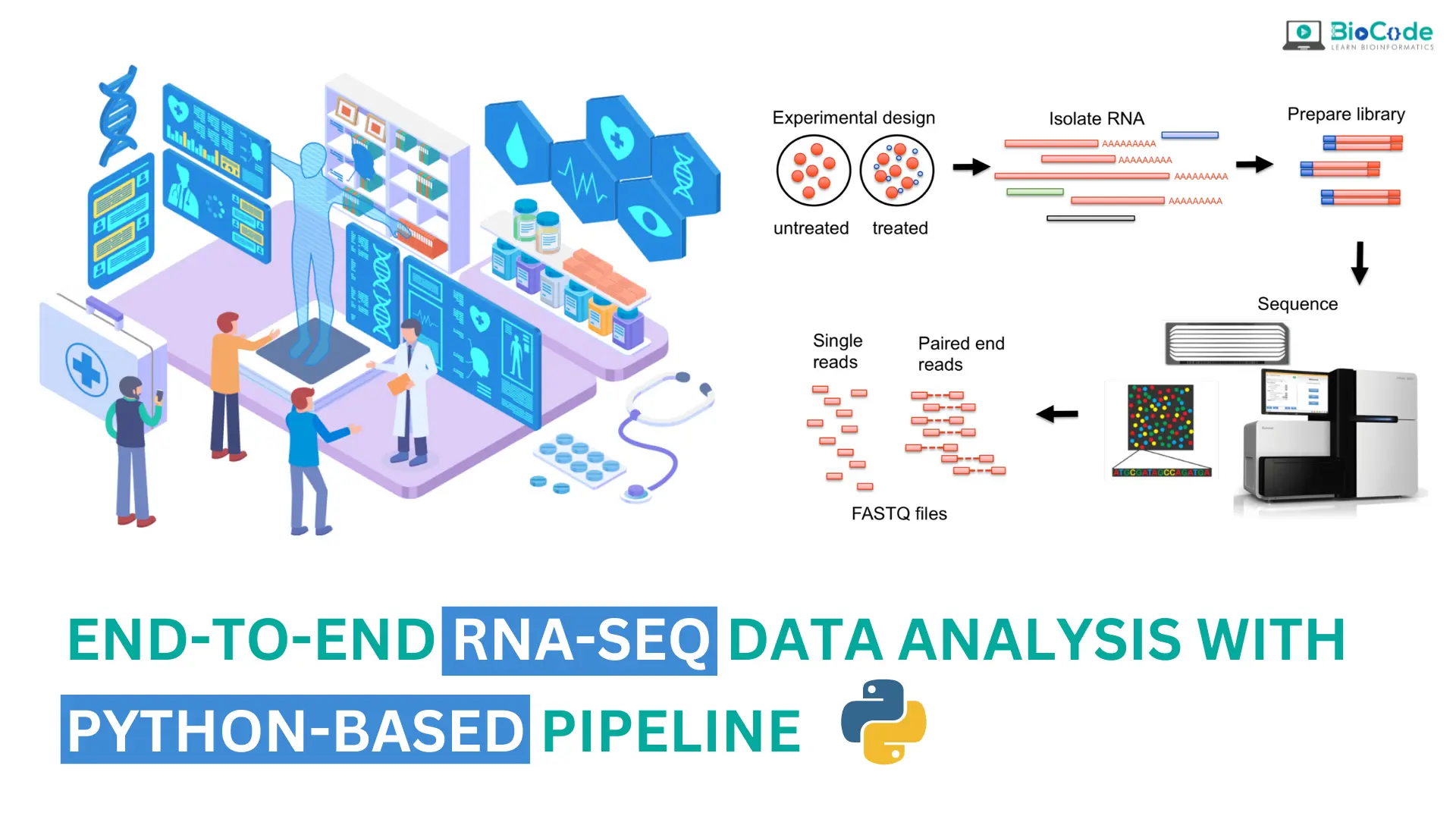
- 2 End-to-End RNA-Seq Data Analysis With Python-Based Pipeline
- 3 Hands-on: Single-Cell RNA-Sequencing Data Analysis Using Command-Line and R [Complete Training]
- 4 Hands-on: Single-Cell RNA-Sequencing Data Analysis Using Python [Complete Training] · you're here
Not ready to enrol?
Get the free syllabus & course updates
We'll email you the full outline for this course plus a starter guide — no spam, unsubscribe anytime.
Tools & technologies you'll use
- Python
- Linux
- Bash / CLI
- Seurat
- Scanpy
- Machine Learning
Course Content
In-depth Introduction to Single Cell RNA-Sequencing, Pipeline and Single-Cell Technologies
-
Introduction to Single-Cell RNA-seq, Its Pipeline and Analysis
23:34 -
Gene Expression and Its Significance
21:42 -
Cellular and Tumor Heterogeneity
09:10 -
Bulk RNA-sequencing vs. Single-Cell RNA-sequencing
21:50 -
Single-Cell RNA-seq Technologies (10x Genomics, Smart-Seq, Drop-seq and more)
23:09 -
Cell Isolation and Cell Lysis Protocols for Single-Cell Genomics
09:53 -
In-depth Introduction to Single-Cell RNA-sequencing Analysis Pipeline
24:45 -
Droplet Technologies: 10x Genomics
14:10 -
Full-Length Transcript Technologies: Smart-Seq2
17:55
Hands-on Single-Cell RNA-seq Data Analysis (From Raw Reads to Cell Subpopulation Identification and DEGs Identification)
Additional Supplementary Lectures
Earn a certificate
Add this certificate to your resume to demonstrate your skills & increase your chances of getting noticed.
Student Ratings & Reviews
Common questions
Do I need any prior experience for this course?
The course is taught from first principles, so you do not need previous experience with the specific tools it covers. A working understanding of molecular biology will help you get more from it.
How long do I have access after enrolling?
Access is lifetime. Once you enrol you keep the course and any future updates to it, with no recurring fee.
Do I get a certificate?
Yes — you receive a certificate of completion once you finish the course, which you can share on LinkedIn or include in a CV.
Is this course hands-on or theory only?
It is project-based. You work with real research datasets and run the analyses yourself rather than only watching them being explained.
![Hands-on: Single-Cell RNA-Sequencing Data Analysis Using Command-Line and R [Complete Training]](https://www.biocode.org.uk/wp-content/uploads/2023/02/Course-Thumbnail-for-Hands-on-Single-Cell-RNA-Sequencing-Data-Analysis-Using-Command-Line-and-R.webp)

