Choose how you want to learn
MicroArray Analysis
Included with All-Access Core
This course is part of All-Access Core, so a membership opens it along with the rest of the core library. Annual All Access includes it too.
Compare both plans →Already bought this course? Sign in to start learning.
MicroArray Analysis
About Course
“Microarray Analysis and Differential Expression with R” is a comprehensive course that teaches participants to analyze microarray data and perform differential expression analysis using R. The course covers the entire workflow, including data retrieval, preprocessing, quality control, normalization, and differential expression analysis.
It starts with an introduction to microarray technology, its principles, and applications. Participants learn the basics of R programming and its significance in microarray analysis. They retrieve raw data from microarray databases for analysis, whether related to cancer or other diseases.
Quality control ensures data reliability and accuracy. Participants learn quality control measures, assess data quality, and explore normalization techniques to enhance comparability.
Differential expression analysis identifies genes differentially expressed between experimental conditions. Statistical methods are taught, along with hands-on experience in implementing them using R. Participants interpret and visualize results to gain biological insights.
The course includes practical examples, exercises, and case studies. By the end, participants confidently analyze microarray data, perform differential expression analysis, and extract insights from their own datasets.
Whether students, researchers, or professionals in genomics or other biological disciplines, this course empowers them to leverage microarray technology and R programming for robust gene expression analysis. Join us and unlock new possibilities in research and disease understanding.
Learning Objectives:
- Introduction to Microarray Analysis & R:
- Understand microarray principles and applications
- Learn R basics for microarray analysis
- Retrieve and preprocess microarray data in R
- Quality Control & Normalization:
- Learn quality control measures and their significance
- Assess microarray data quality and identify variations
- Explore normalization methods using R
- Differential Expression Analysis:
- Understand differential gene expression and its importance
- Learn statistical methods for identifying differentially expressed genes
- Perform differential expression analysis using R
- Interpret and visualize results for biological insights.
Microarray analysis and differential expression in R
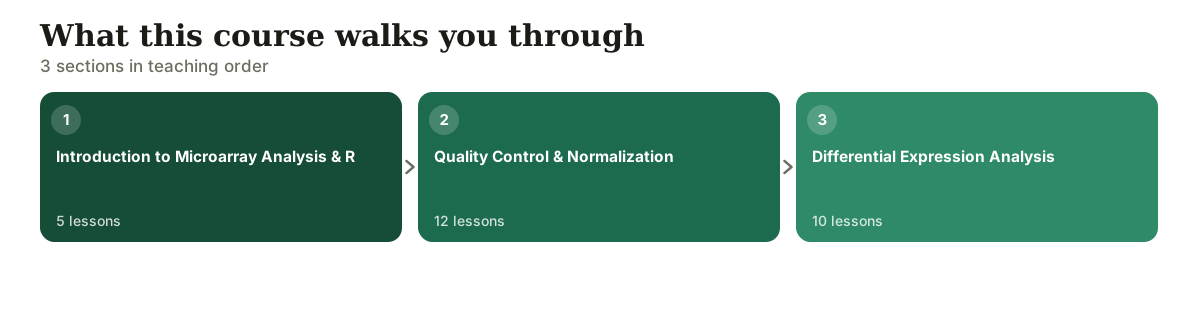
Microarrays predate RNA-Seq but remain widely used, and — more importantly — the public archives hold decades of microarray data. GEO and ArrayExpress contain tens of thousands of experiments that have never been reanalysed. This focused course, about 1 hour 20 minutes across three sections, teaches you to work with that data in R.
What you work through
- Microarray analysis and R — how hybridisation-based measurement differs from sequencing, and what that means for the statistics.
- Quality control and normalisation — the step that matters most. Array data carries technical variation that will dominate your results if left uncorrected, and the normalisation choice changes which genes appear significant.
- Differential expression analysis — identifying genes that genuinely differ between conditions, and interpreting the result.
Why microarrays still matter
Two practical reasons. First, the archives: if your research question has been studied before, there is a good chance the data already exists and is free. Reanalysing public microarray data is one of the cheapest ways to generate a real result or a pilot for a grant. Second, cost — for targeted questions on large sample numbers, arrays remain economical.
The statistical reasoning also transfers directly. Normalisation, multiple testing correction and experimental design work the same way in RNA-Seq; learning them on the simpler platform makes the sequencing version easier.
What you can do afterwards
Download a microarray dataset from GEO, assess its quality, normalise it appropriately, run differential expression in R, and interpret the output — including knowing when the data is not good enough to use.
Who it suits
Researchers with existing array data, anyone wanting to mine public expression archives, and students who want the statistics of expression analysis on a platform with fewer moving parts than RNA-Seq.
Not ready to enrol?
Get the free syllabus & course updates
We'll email you the full outline for this course plus a starter guide — no spam, unsubscribe anytime.
This course is part of All-Access Core, so $21.74 a month opens it along with the rest of the core library. See what that opens
Tools & technologies you'll use
- R
Free preview — sample these lessons before you enrol
Course Content
Introduction to Microarray Analysis & R
-
09:56
-
Introduction to BioConductor – Installating MicroArray Packages
05:06 -
Getting Started with R Studio Project for MicroArray Analysis
04:51 -
Downloading MicroArray Raw Data from ArrayExpress
04:19 -
Creating Raw Intensities MicroArray Data Structure and Log2 Transformation
14:41
Quality Control & Normalization
Differential Expression Analysis
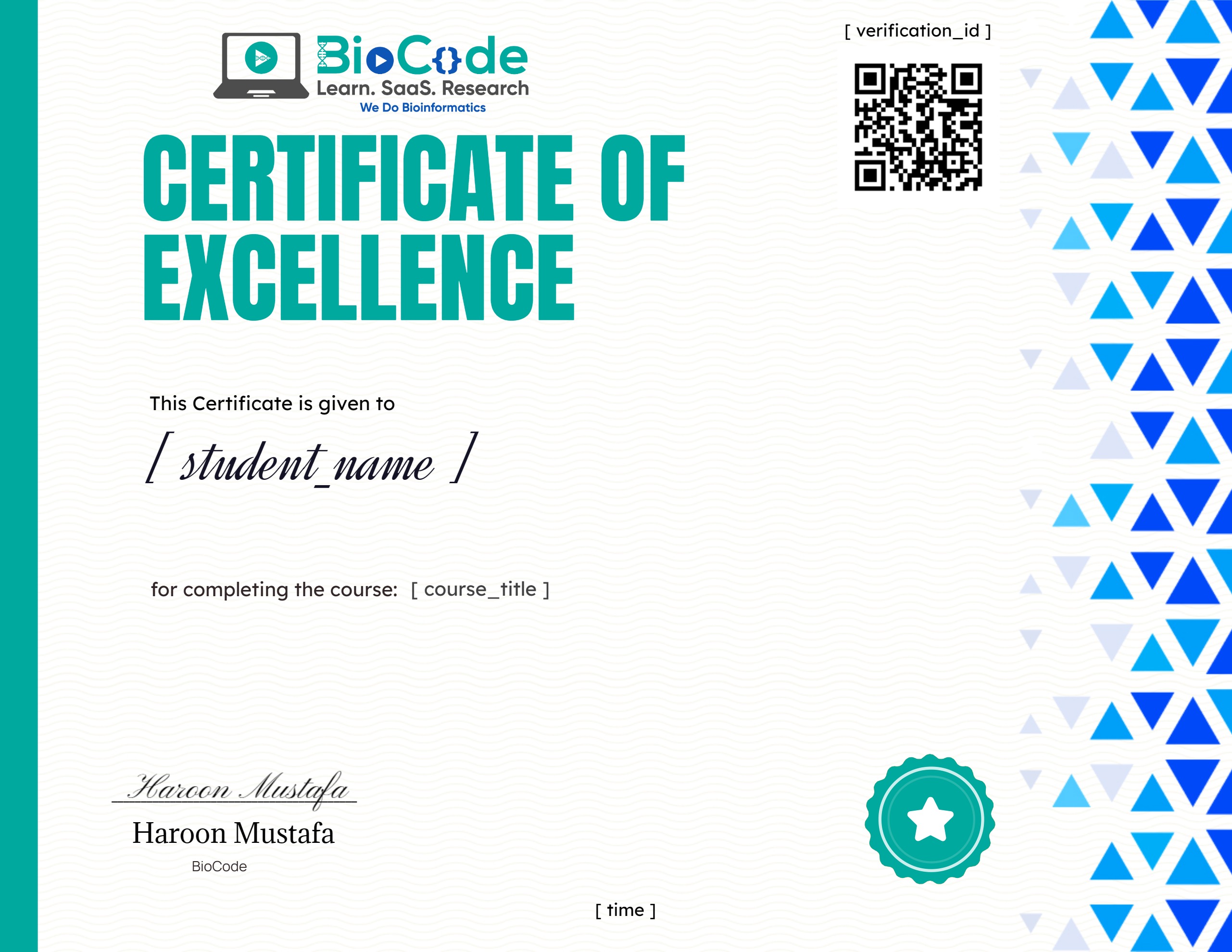
Earn a certificate
Add this certificate to your resume to demonstrate your skills & increase your chances of getting noticed.
Student Ratings & Reviews
Who this course is for
- The target audience for the Microarray Analysis For Bioinformatics are biologists, beginner or intermediate Bioinformaticians or data analysts with no or little experience in applications of computational bioinformatics and analysis.
- However, a superficial understanding of molecular biology and logic development for coding is expected from you before you join the course.
- Bioinformatics is quite easy to get started in, even if you lack a proper understanding of the underlying concepts of Bioinformatics databases, servers, tools and the algorithms working behind them.
Common questions
Do I need any prior experience for this course?
The course is taught from first principles, so you do not need previous experience with the specific tools it covers. A working understanding of molecular biology will help you get more from it.
How long does MicroArray Analysis take to complete?
The course contains roughly 1 hour 20 minutes of material across 3 sections. It is self-paced, so you can work through it as quickly or slowly as suits you.
How long do I have access after enrolling?
Access is lifetime. Once you enrol you keep the course and any future updates to it, with no recurring fee.
Do I get a certificate?
Yes — you receive a certificate of completion once you finish the course, which you can share on LinkedIn or include in a CV.
Is this course hands-on or theory only?
It is project-based. You work with real research datasets and run the analyses yourself rather than only watching them being explained.

